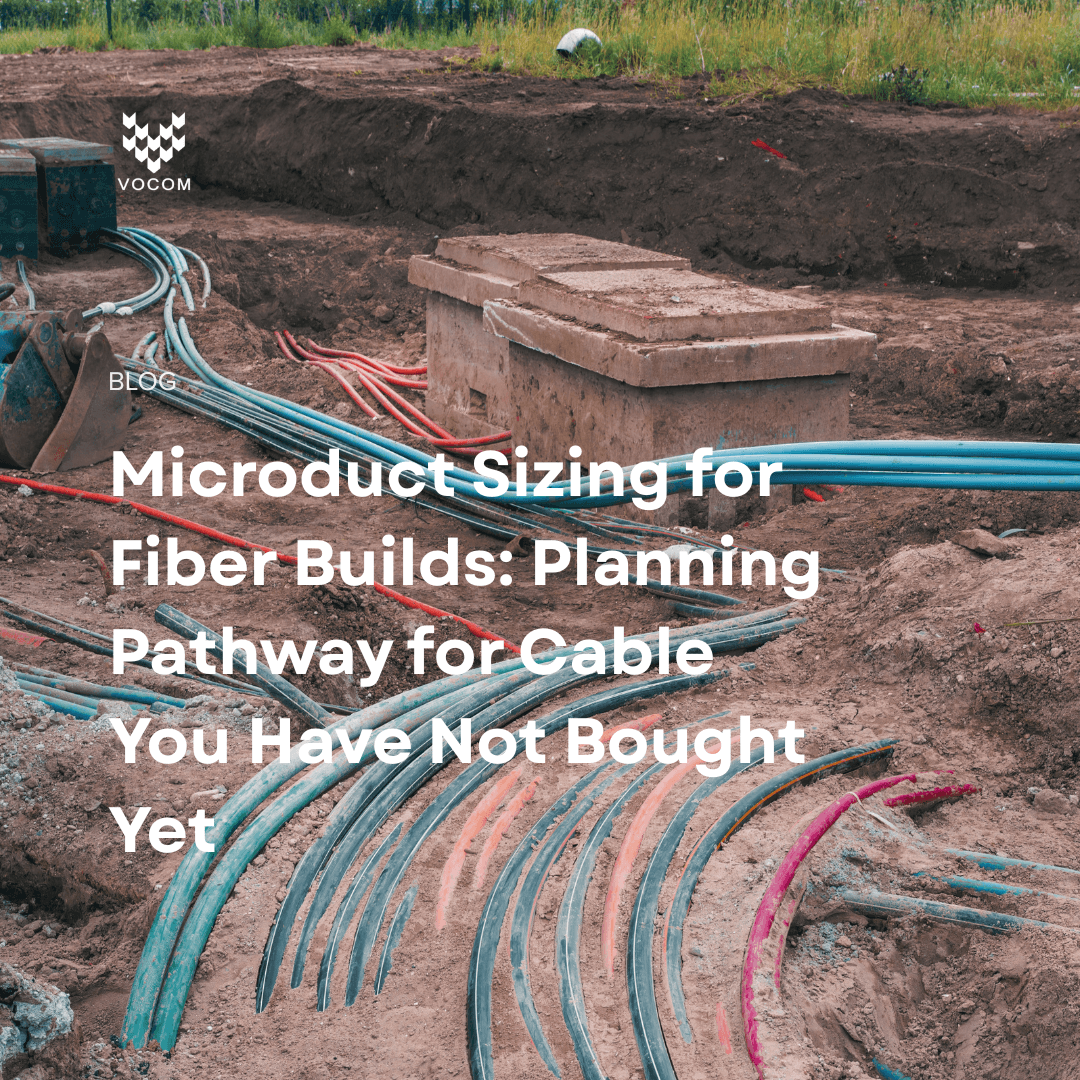
Microduct Sizing for Fiber Builds: Planning Pathway for Cable You Have Not Bought Yet
Almost everything in an outside plant build can be revisited. Counts can be added, splice points moved, hardware swapped. The pathway cannot. Once a trench is closed, changing what is in the ground means opening it again, and the second dig costs more than the first because the route now has live services in it.
That asymmetry is the whole argument for microduct, and it is why pathway sizing deserves more attention than it usually gets. The cable going in today is a known quantity. The cable going in five years from now is not, and the bundle you put in the ground this month decides whether that future cable is a blow or an excavation.
The awkward part is that you have to size the pathway before you know what will eventually occupy it. This article works through how that decision is actually made, in the order it gets made, and where the expensive mistakes sit.
Almost everything in an outside plant build can be revisited. Counts can be added, splice points moved, hardware swapped. The pathway cannot. Once a trench is closed, changing what is in the ground means opening it again, and the second dig costs more than the first because the route now has live services in it.
That asymmetry is the whole argument for microduct, and it is why pathway sizing deserves more attention than it usually gets. The cable going in today is a known quantity. The cable going in five years from now is not, and the bundle you put in the ground this month decides whether that future cable is a blow or an excavation.
The awkward part is that you have to size the pathway before you know what will eventually occupy it. This article works through how that decision is actually made, in the order it gets made, and where the expensive mistakes sit.
Almost everything in an outside plant build can be revisited. Counts can be added, splice points moved, hardware swapped. The pathway cannot. Once a trench is closed, changing what is in the ground means opening it again, and the second dig costs more than the first because the route now has live services in it.
That asymmetry is the whole argument for microduct, and it is why pathway sizing deserves more attention than it usually gets. The cable going in today is a known quantity. The cable going in five years from now is not, and the bundle you put in the ground this month decides whether that future cable is a blow or an excavation.
The awkward part is that you have to size the pathway before you know what will eventually occupy it. This article works through how that decision is actually made, in the order it gets made, and where the expensive mistakes sit.
What a Microduct Bundle Actually Is
A microduct is a small-bore HDPE tube built to have fiber blown through it rather than pulled. A bundle is a set of those tubes under one outer sheath, color coded so each way can be identified at both ends and years apart.
The point of the bundle is that the tubes go in together, once. A direct-buried cable occupies the trench it is in. A bundle occupies the same trench but arrives as a set of separate, individually usable pathways. One way can be blown today, a second in eighteen months for a new customer or a new route, and the remainder held. Each of those later blows uses a pathway that has already been paid for.
Bundles come in configurations from a few ways up to twenty-four or twenty-five, and individual microducts are also available as single-way runs for shorter spurs or for adding a pathway alongside existing plant. Which configuration is right is not a question about the cable at all. It is a question about how many independent routes this trench might ever need to carry.
A microduct is a small-bore HDPE tube built to have fiber blown through it rather than pulled. A bundle is a set of those tubes under one outer sheath, color coded so each way can be identified at both ends and years apart.
The point of the bundle is that the tubes go in together, once. A direct-buried cable occupies the trench it is in. A bundle occupies the same trench but arrives as a set of separate, individually usable pathways. One way can be blown today, a second in eighteen months for a new customer or a new route, and the remainder held. Each of those later blows uses a pathway that has already been paid for.
Bundles come in configurations from a few ways up to twenty-four or twenty-five, and individual microducts are also available as single-way runs for shorter spurs or for adding a pathway alongside existing plant. Which configuration is right is not a question about the cable at all. It is a question about how many independent routes this trench might ever need to carry.
A microduct is a small-bore HDPE tube built to have fiber blown through it rather than pulled. A bundle is a set of those tubes under one outer sheath, color coded so each way can be identified at both ends and years apart.
The point of the bundle is that the tubes go in together, once. A direct-buried cable occupies the trench it is in. A bundle occupies the same trench but arrives as a set of separate, individually usable pathways. One way can be blown today, a second in eighteen months for a new customer or a new route, and the remainder held. Each of those later blows uses a pathway that has already been paid for.
Bundles come in configurations from a few ways up to twenty-four or twenty-five, and individual microducts are also available as single-way runs for shorter spurs or for adding a pathway alongside existing plant. Which configuration is right is not a question about the cable at all. It is a question about how many independent routes this trench might ever need to carry.
Sizing the Ways, Not the Cable
The sequence that works starts with the route, not the product.
Begin by counting the destinations this trench serves or could serve. Not fiber counts, routes. A feeder run past a business park, an industrial site and a planned residential phase is three potential pathways even if only one of them is funded. The number of ways is a forecast of independent future users, and that forecast is the part worth spending an afternoon on.
Then set the internal diameter of each way against the largest cable it might reasonably carry rather than the cable it will carry first. Micro cable is available across a wide count range, and higher counts mean larger outer diameters. A way sized for the first cable is a way that cannot take the upgrade. A way sized generously wastes a little space and preserves every option, and space in a bundle is cheap compared with a trench.
Then check fill ratio. A cable needs clearance to travel on air, and a cable that nearly fills its duct will not blow well or far. Fill ratio is what separates a route that installs in a day from one that needs an intermediate excavation, and it is the single number most often left to the installer to discover.
Finally, decide what is being installed now and what is being reserved. Empty ways should be capped and recorded properly, because an unrecorded spare way is functionally the same as no spare way. That sounds obvious. It is also the most common way pathway value gets lost: the bundle is in the ground, the as-built is vague, and three years later nobody can say with confidence which tube is free.
The sequence that works starts with the route, not the product.
Begin by counting the destinations this trench serves or could serve. Not fiber counts, routes. A feeder run past a business park, an industrial site and a planned residential phase is three potential pathways even if only one of them is funded. The number of ways is a forecast of independent future users, and that forecast is the part worth spending an afternoon on.
Then set the internal diameter of each way against the largest cable it might reasonably carry rather than the cable it will carry first. Micro cable is available across a wide count range, and higher counts mean larger outer diameters. A way sized for the first cable is a way that cannot take the upgrade. A way sized generously wastes a little space and preserves every option, and space in a bundle is cheap compared with a trench.
Then check fill ratio. A cable needs clearance to travel on air, and a cable that nearly fills its duct will not blow well or far. Fill ratio is what separates a route that installs in a day from one that needs an intermediate excavation, and it is the single number most often left to the installer to discover.
Finally, decide what is being installed now and what is being reserved. Empty ways should be capped and recorded properly, because an unrecorded spare way is functionally the same as no spare way. That sounds obvious. It is also the most common way pathway value gets lost: the bundle is in the ground, the as-built is vague, and three years later nobody can say with confidence which tube is free.
The sequence that works starts with the route, not the product.
Begin by counting the destinations this trench serves or could serve. Not fiber counts, routes. A feeder run past a business park, an industrial site and a planned residential phase is three potential pathways even if only one of them is funded. The number of ways is a forecast of independent future users, and that forecast is the part worth spending an afternoon on.
Then set the internal diameter of each way against the largest cable it might reasonably carry rather than the cable it will carry first. Micro cable is available across a wide count range, and higher counts mean larger outer diameters. A way sized for the first cable is a way that cannot take the upgrade. A way sized generously wastes a little space and preserves every option, and space in a bundle is cheap compared with a trench.
Then check fill ratio. A cable needs clearance to travel on air, and a cable that nearly fills its duct will not blow well or far. Fill ratio is what separates a route that installs in a day from one that needs an intermediate excavation, and it is the single number most often left to the installer to discover.
Finally, decide what is being installed now and what is being reserved. Empty ways should be capped and recorded properly, because an unrecorded spare way is functionally the same as no spare way. That sounds obvious. It is also the most common way pathway value gets lost: the bundle is in the ground, the as-built is vague, and three years later nobody can say with confidence which tube is free.
What Blowing Distance Actually Depends On
Blowing, or jetting, moves a cable by pushing air past it so the cable travels on a cushion rather than being dragged. It is what makes long single-shot installs possible, and it is sensitive to several things at once.
Cable weight and stiffness matter, because a lighter cable with a low friction sheath moves further on the same pressure. Duct internal surface matters, which is why many microducts have a ribbed or low friction inner wall. The route matters most of all: every bend consumes distance, and a route with many bends will fall well short of what the same cable achieves on a straight run. Temperature, lubricant and the condition of the duct all contribute.
The practical consequence is that blowing distance is a property of the whole system rather than a specification on any one component. A supplier quoting a distance figure is quoting it under assumptions, and the useful question is which assumptions. On a long route the answer is often to plan intermediate access points from the start rather than discover the need for one halfway through the install, which is a different and much worse problem.
This is also where cable and duct choices stop being independent. A low friction jacket, a sensible fill ratio and a route planned with bends in mind are one decision made in three places. Getting two of the three right still leaves the install to the crew and the weather.
Blowing, or jetting, moves a cable by pushing air past it so the cable travels on a cushion rather than being dragged. It is what makes long single-shot installs possible, and it is sensitive to several things at once.
Cable weight and stiffness matter, because a lighter cable with a low friction sheath moves further on the same pressure. Duct internal surface matters, which is why many microducts have a ribbed or low friction inner wall. The route matters most of all: every bend consumes distance, and a route with many bends will fall well short of what the same cable achieves on a straight run. Temperature, lubricant and the condition of the duct all contribute.
The practical consequence is that blowing distance is a property of the whole system rather than a specification on any one component. A supplier quoting a distance figure is quoting it under assumptions, and the useful question is which assumptions. On a long route the answer is often to plan intermediate access points from the start rather than discover the need for one halfway through the install, which is a different and much worse problem.
This is also where cable and duct choices stop being independent. A low friction jacket, a sensible fill ratio and a route planned with bends in mind are one decision made in three places. Getting two of the three right still leaves the install to the crew and the weather.
Blowing, or jetting, moves a cable by pushing air past it so the cable travels on a cushion rather than being dragged. It is what makes long single-shot installs possible, and it is sensitive to several things at once.
Cable weight and stiffness matter, because a lighter cable with a low friction sheath moves further on the same pressure. Duct internal surface matters, which is why many microducts have a ribbed or low friction inner wall. The route matters most of all: every bend consumes distance, and a route with many bends will fall well short of what the same cable achieves on a straight run. Temperature, lubricant and the condition of the duct all contribute.
The practical consequence is that blowing distance is a property of the whole system rather than a specification on any one component. A supplier quoting a distance figure is quoting it under assumptions, and the useful question is which assumptions. On a long route the answer is often to plan intermediate access points from the start rather than discover the need for one halfway through the install, which is a different and much worse problem.
This is also where cable and duct choices stop being independent. A low friction jacket, a sensible fill ratio and a route planned with bends in mind are one decision made in three places. Getting two of the three right still leaves the install to the crew and the weather.
Where This Lands on a Real Build
The whole sequence takes an afternoon at design stage and cannot be recovered afterward. Count the routes the trench could serve. Size the ways against the largest plausible cable. Check fill. Record what is empty. Plan the blow against the route rather than the catalog.
Vocom International supplies both halves of that decision. Its micro and duct range covers HDPE microduct in bundled and single-way configurations alongside air blown micro cable built for jetting, sourced build-to-order through tier 1 manufacturing partners on Fujikura preform glass. Standard lead time is 6 to 8 weeks, expedited production is available, and custom builds run up to 10 weeks. For the wider route decision that sits above this one, our aerial or buried guide covers the same ground a level up: vocom.ai/blog/aerial-vs-buried-outside-plant-fiber
If you are sizing pathway for a route that has to last twenty years, send the route profile and the counts you expect to blow first. The bundle can be specified around what comes after. Talk to a specifier: vocom.ai/contact-vocomai
The whole sequence takes an afternoon at design stage and cannot be recovered afterward. Count the routes the trench could serve. Size the ways against the largest plausible cable. Check fill. Record what is empty. Plan the blow against the route rather than the catalog.
Vocom International supplies both halves of that decision. Its micro and duct range covers HDPE microduct in bundled and single-way configurations alongside air blown micro cable built for jetting, sourced build-to-order through tier 1 manufacturing partners on Fujikura preform glass. Standard lead time is 6 to 8 weeks, expedited production is available, and custom builds run up to 10 weeks. For the wider route decision that sits above this one, our aerial or buried guide covers the same ground a level up: vocom.ai/blog/aerial-vs-buried-outside-plant-fiber
If you are sizing pathway for a route that has to last twenty years, send the route profile and the counts you expect to blow first. The bundle can be specified around what comes after. Talk to a specifier: vocom.ai/contact-vocomai
The whole sequence takes an afternoon at design stage and cannot be recovered afterward. Count the routes the trench could serve. Size the ways against the largest plausible cable. Check fill. Record what is empty. Plan the blow against the route rather than the catalog.
Vocom International supplies both halves of that decision. Its micro and duct range covers HDPE microduct in bundled and single-way configurations alongside air blown micro cable built for jetting, sourced build-to-order through tier 1 manufacturing partners on Fujikura preform glass. Standard lead time is 6 to 8 weeks, expedited production is available, and custom builds run up to 10 weeks. For the wider route decision that sits above this one, our aerial or buried guide covers the same ground a level up: vocom.ai/blog/aerial-vs-buried-outside-plant-fiber
If you are sizing pathway for a route that has to last twenty years, send the route profile and the counts you expect to blow first. The bundle can be specified around what comes after. Talk to a specifier: vocom.ai/contact-vocomai