AI’s Real Impact on Work: What It Means for Supply Chains
Artificial intelligence is often discussed in extremes.
Some predict mass job displacement. Others claim AI will transform every industry overnight. But new research suggests the reality is more nuanced, and far more interesting.
A recent report from Anthropic examined how AI is actually being used across the labor market. Their analysis compared the theoretical capability of AI systems with real-world usage data, revealing an important insight:
Artificial intelligence is often discussed in extremes.
Some predict mass job displacement. Others claim AI will transform every industry overnight. But new research suggests the reality is more nuanced, and far more interesting.
A recent report from Anthropic examined how AI is actually being used across the labor market. Their analysis compared the theoretical capability of AI systems with real-world usage data, revealing an important insight:
Artificial intelligence is often discussed in extremes.
Some predict mass job displacement. Others claim AI will transform every industry overnight. But new research suggests the reality is more nuanced, and far more interesting.
A recent report from Anthropic examined how AI is actually being used across the labor market. Their analysis compared the theoretical capability of AI systems with real-world usage data, revealing an important insight:
AI’s Real Impact on Work: What It Means for Supply Chains
Artificial intelligence is often discussed in extremes.
Some predict mass job displacement. Others claim AI will transform every industry overnight. But new research suggests the reality is more nuanced, and far more interesting.
A recent report from Anthropic examined how AI is actually being used across the labor market. Their analysis compared the theoretical capability of AI systems with real-world usage data, revealing an important insight:
AI is still operating far below its theoretical potential.
In other words, while large language models and advanced AI systems can theoretically assist with a wide range of tasks, most organizations have not yet deployed them deeply in operational environments.
This gap between capability and adoption represents one of the biggest opportunities in modern business.
And nowhere is that opportunity clearer than in global supply chains.
Artificial intelligence is often discussed in extremes.
Some predict mass job displacement. Others claim AI will transform every industry overnight. But new research suggests the reality is more nuanced, and far more interesting.
A recent report from Anthropic examined how AI is actually being used across the labor market. Their analysis compared the theoretical capability of AI systems with real-world usage data, revealing an important insight:
AI is still operating far below its theoretical potential.
In other words, while large language models and advanced AI systems can theoretically assist with a wide range of tasks, most organizations have not yet deployed them deeply in operational environments.
This gap between capability and adoption represents one of the biggest opportunities in modern business.
And nowhere is that opportunity clearer than in global supply chains.
Artificial intelligence is often discussed in extremes.
Some predict mass job displacement. Others claim AI will transform every industry overnight. But new research suggests the reality is more nuanced, and far more interesting.
A recent report from Anthropic examined how AI is actually being used across the labor market. Their analysis compared the theoretical capability of AI systems with real-world usage data, revealing an important insight:
AI is still operating far below its theoretical potential.
In other words, while large language models and advanced AI systems can theoretically assist with a wide range of tasks, most organizations have not yet deployed them deeply in operational environments.
This gap between capability and adoption represents one of the biggest opportunities in modern business.
And nowhere is that opportunity clearer than in global supply chains.
The Gap Between AI Potential and Reality
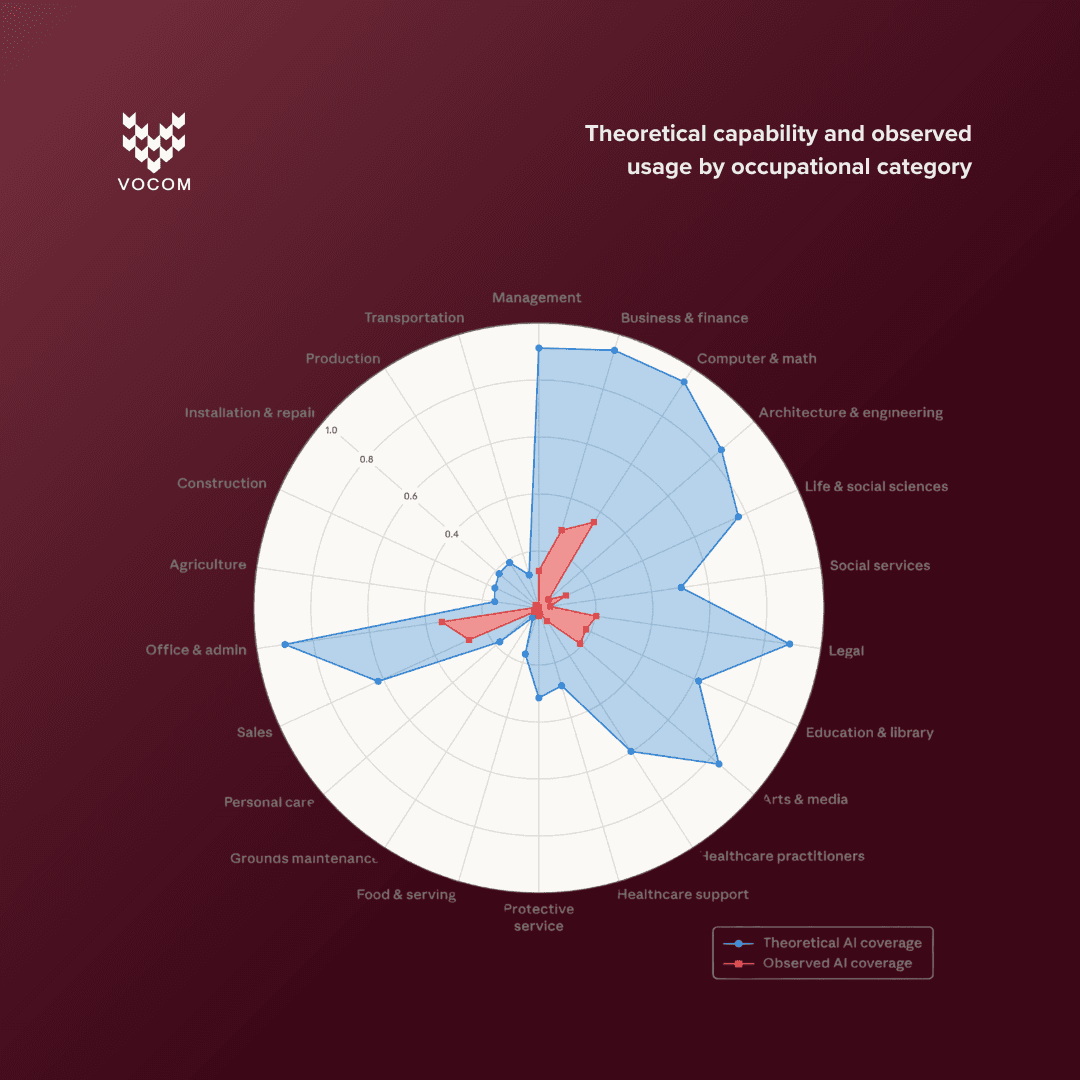
The research highlights a key concept: observed exposure.
Observed exposure measures how often AI is actually being used in professional tasks compared to how capable AI could theoretically be.
The findings show that many industries have high potential AI coverage, but real-world adoption remains limited.
For example:
• AI systems are capable of assisting with a large portion of tasks in areas like computing, business operations, and analytics.
• However, actual deployment within professional environments still covers only a fraction of those tasks.
• In many industries, AI usage remains concentrated in isolated workflows rather than integrated systems.
The conclusion is simple.
The technology is advancing faster than the way organizations deploy it.
This isn’t surprising. Implementing AI across real operational environments is far more complex than testing it in isolated tools.
Organizations must integrate data sources, build operational workflows, and ensure the outputs are reliable enough to support real decision-making.
This is particularly true in industries where the stakes are high, such as supply chain operations.
The research highlights a key concept: observed exposure.
Observed exposure measures how often AI is actually being used in professional tasks compared to how capable AI could theoretically be.
The findings show that many industries have high potential AI coverage, but real-world adoption remains limited.
For example:
• AI systems are capable of assisting with a large portion of tasks in areas like computing, business operations, and analytics.
• However, actual deployment within professional environments still covers only a fraction of those tasks.
• In many industries, AI usage remains concentrated in isolated workflows rather than integrated systems.
The conclusion is simple.
The technology is advancing faster than the way organizations deploy it.
This isn’t surprising. Implementing AI across real operational environments is far more complex than testing it in isolated tools.
Organizations must integrate data sources, build operational workflows, and ensure the outputs are reliable enough to support real decision-making.
This is particularly true in industries where the stakes are high, such as supply chain operations.
The research highlights a key concept: observed exposure.
Observed exposure measures how often AI is actually being used in professional tasks compared to how capable AI could theoretically be.
The findings show that many industries have high potential AI coverage, but real-world adoption remains limited.
For example:
• AI systems are capable of assisting with a large portion of tasks in areas like computing, business operations, and analytics.
• However, actual deployment within professional environments still covers only a fraction of those tasks.
• In many industries, AI usage remains concentrated in isolated workflows rather than integrated systems.
The conclusion is simple.
The technology is advancing faster than the way organizations deploy it.
This isn’t surprising. Implementing AI across real operational environments is far more complex than testing it in isolated tools.
Organizations must integrate data sources, build operational workflows, and ensure the outputs are reliable enough to support real decision-making.
This is particularly true in industries where the stakes are high, such as supply chain operations.
Why Supply Chains Are an Ideal Use Case for AI
Supply chains generate enormous volumes of data.
Every day, organizations track:
• supplier performance
• logistics flows
• market demand
• trade patterns
• environmental signals
• inventory movements
• production schedules
Despite this abundance of data, many companies still struggle to transform information into clear operational decisions.
Data often lives across multiple systems:
ERP platforms
logistics software
supplier databases
procurement systems
external market data feeds
When these systems remain disconnected, organizations lose visibility into how their supply chain is truly performing.
The result is a reactive approach to operations.
Teams discover problems after they have already impacted production, deliveries, or costs.
AI has the potential to change this dynamic completely.
When applied correctly, AI systems can connect fragmented data sources and identify patterns that human teams would struggle to detect at scale.
This is where the next phase of supply chain transformation begins.
Supply chains generate enormous volumes of data.
Every day, organizations track:
• supplier performance
• logistics flows
• market demand
• trade patterns
• environmental signals
• inventory movements
• production schedules
Despite this abundance of data, many companies still struggle to transform information into clear operational decisions.
Data often lives across multiple systems:
ERP platforms
logistics software
supplier databases
procurement systems
external market data feeds
When these systems remain disconnected, organizations lose visibility into how their supply chain is truly performing.
The result is a reactive approach to operations.
Teams discover problems after they have already impacted production, deliveries, or costs.
AI has the potential to change this dynamic completely.
When applied correctly, AI systems can connect fragmented data sources and identify patterns that human teams would struggle to detect at scale.
This is where the next phase of supply chain transformation begins.
Supply chains generate enormous volumes of data.
Every day, organizations track:
• supplier performance
• logistics flows
• market demand
• trade patterns
• environmental signals
• inventory movements
• production schedules
Despite this abundance of data, many companies still struggle to transform information into clear operational decisions.
Data often lives across multiple systems:
ERP platforms
logistics software
supplier databases
procurement systems
external market data feeds
When these systems remain disconnected, organizations lose visibility into how their supply chain is truly performing.
The result is a reactive approach to operations.
Teams discover problems after they have already impacted production, deliveries, or costs.
AI has the potential to change this dynamic completely.
When applied correctly, AI systems can connect fragmented data sources and identify patterns that human teams would struggle to detect at scale.
This is where the next phase of supply chain transformation begins.
Moving from Reactive to Predictive Supply Chains
The traditional supply chain model relies heavily on historical data and manual analysis.
Planning teams analyze past performance, apply forecasting models, and attempt to anticipate future demand.
But modern supply chains operate in an environment where change happens constantly.
Weather events disrupt agricultural production.
Trade policies alter sourcing strategies.
Geopolitical shifts impact manufacturing capacity.
Transportation delays cascade across logistics networks.
These disruptions rarely appear in historical data until it is already too late.
AI introduces a different approach.
Instead of relying only on past trends, organizations can incorporate real-time external signals into their operational planning.
Examples include:
climate and weather patterns
trade flow data
economic indicators
satellite imagery
market demand signals
supplier risk metrics
By analyzing these signals alongside internal operational data, AI systems can detect emerging risks and opportunities earlier than traditional analytics tools.
This shift transforms supply chains from reactive systems into predictive ones.
The traditional supply chain model relies heavily on historical data and manual analysis.
Planning teams analyze past performance, apply forecasting models, and attempt to anticipate future demand.
But modern supply chains operate in an environment where change happens constantly.
Weather events disrupt agricultural production.
Trade policies alter sourcing strategies.
Geopolitical shifts impact manufacturing capacity.
Transportation delays cascade across logistics networks.
These disruptions rarely appear in historical data until it is already too late.
AI introduces a different approach.
Instead of relying only on past trends, organizations can incorporate real-time external signals into their operational planning.
Examples include:
climate and weather patterns
trade flow data
economic indicators
satellite imagery
market demand signals
supplier risk metrics
By analyzing these signals alongside internal operational data, AI systems can detect emerging risks and opportunities earlier than traditional analytics tools.
This shift transforms supply chains from reactive systems into predictive ones.
The traditional supply chain model relies heavily on historical data and manual analysis.
Planning teams analyze past performance, apply forecasting models, and attempt to anticipate future demand.
But modern supply chains operate in an environment where change happens constantly.
Weather events disrupt agricultural production.
Trade policies alter sourcing strategies.
Geopolitical shifts impact manufacturing capacity.
Transportation delays cascade across logistics networks.
These disruptions rarely appear in historical data until it is already too late.
AI introduces a different approach.
Instead of relying only on past trends, organizations can incorporate real-time external signals into their operational planning.
Examples include:
climate and weather patterns
trade flow data
economic indicators
satellite imagery
market demand signals
supplier risk metrics
By analyzing these signals alongside internal operational data, AI systems can detect emerging risks and opportunities earlier than traditional analytics tools.
This shift transforms supply chains from reactive systems into predictive ones.
From Operational Intelligence to an AI-Driven Future
From Operational Intelligence to an AI-Driven Future
From Operational Intelligence to an AI-Driven Future
The Anthropic research highlights an important lesson for organizations exploring AI adoption.
Technology alone does not create impact.
Impact comes from integrating AI into real operational workflows.
Many early AI deployments focused on individual productivity tools. These tools are valuable, but they often operate separately from core business systems.
Operational environments require something different.
They require AI systems that understand complex data relationships and support decision-making at scale.
This is particularly important in supply chains, where decisions often involve:
multi-region supplier networks
dynamic transportation routes
variable demand patterns
regulatory constraints
environmental factors
These systems generate enormous amounts of structured and unstructured data.
Without intelligent analysis, organizations struggle to convert this data into meaningful insights.
Operational intelligence platforms bridge this gap.
They combine AI capabilities with integrated data environments to support high-impact decisions.
One of the paradoxes of modern supply chains is that organizations often have more data than ever before, yet still struggle to make confident decisions.
The challenge is not data availability.
The challenge is data interpretation.
When thousands of variables influence operational outcomes, it becomes extremely difficult for human teams to analyze every possible scenario.
AI systems excel in these environments.
They can process large datasets, detect correlations, and simulate potential outcomes across multiple variables simultaneously.
For example, AI can model how changes in rainfall patterns may impact agricultural output in a key sourcing region.
It can analyze how those changes might affect commodity prices, supplier capacity, and shipping volumes.
It can then simulate how those variables will influence procurement costs and delivery timelines months into the future.
This type of analysis would traditionally take teams weeks to complete.
AI can perform similar evaluations in minutes.
Despite these advantages, most supply chains have only begun exploring AI-driven decision systems.
There are several reasons for this.
First, supply chains are complex environments with legacy infrastructure and fragmented data architectures.
Second, many organizations are still determining how to integrate AI into existing operational workflows.
Third, decision-makers must trust the outputs before relying on AI to support critical planning processes.
These challenges explain why the gap between theoretical AI capability and observed usage remains large.
But they also highlight where the biggest opportunities exist.
Organizations that successfully bridge this gap will gain significant advantages in efficiency, resilience, and strategic planning.
The next stage of AI adoption will likely focus less on isolated tools and more on integrated operational platforms.
Instead of asking how AI can assist individual tasks, organizations will ask a different question:
How can AI improve the entire decision-making environment?
For supply chains, this means integrating:
internal operational data
external economic signals
climate intelligence
trade data
supplier analytics
logistics monitoring
When these inputs are combined and analyzed using advanced AI systems, organizations gain a level of visibility that was previously impossible.
They move from reacting to disruptions toward anticipating them.
This capability represents a major competitive advantage in industries where margins, timing, and reliability determine success.
The research from Anthropic offers an encouraging message.
AI has not yet reshaped the labor market in dramatic ways. Adoption remains early, and many potential applications have yet to be fully realized.
But the direction of change is clear.
As AI systems improve and organizations integrate them into operational environments, their influence will expand.
Industries that depend on complex decision-making and large datasets, such as supply chains, are among the most likely to see meaningful transformation.
The companies that begin building AI-enabled operational intelligence today will be best positioned to navigate that future.
Exploring AI for Supply Chain Operations
At Vocom AI, we focus on applying artificial intelligence to complex operational environments where data, forecasting, and decision-making intersect.
Our goal is to help organizations transform fragmented information into actionable insights that support resilient, efficient supply chains.
AI does not replace the expertise of supply chain professionals.
Instead, it provides the analytical infrastructure needed to navigate increasingly complex global systems.
Organizations that embrace this approach will gain the clarity needed to plan further ahead, respond faster to disruption, and operate with greater confidence in uncertain environments.
🔻 Interested in exploring how AI can improve supply chain visibility and forecasting?
Contact us for a free consultation or read more about our Supply Chain product:
https://www.vocom.ai/vocomai-supply-chain
The Anthropic research highlights an important lesson for organizations exploring AI adoption.
Technology alone does not create impact.
Impact comes from integrating AI into real operational workflows.
Many early AI deployments focused on individual productivity tools. These tools are valuable, but they often operate separately from core business systems.
Operational environments require something different.
They require AI systems that understand complex data relationships and support decision-making at scale.
This is particularly important in supply chains, where decisions often involve:
multi-region supplier networks
dynamic transportation routes
variable demand patterns
regulatory constraints
environmental factors
These systems generate enormous amounts of structured and unstructured data.
Without intelligent analysis, organizations struggle to convert this data into meaningful insights.
Operational intelligence platforms bridge this gap.
They combine AI capabilities with integrated data environments to support high-impact decisions.
One of the paradoxes of modern supply chains is that organizations often have more data than ever before, yet still struggle to make confident decisions.
The challenge is not data availability.
The challenge is data interpretation.
When thousands of variables influence operational outcomes, it becomes extremely difficult for human teams to analyze every possible scenario.
AI systems excel in these environments.
They can process large datasets, detect correlations, and simulate potential outcomes across multiple variables simultaneously.
For example, AI can model how changes in rainfall patterns may impact agricultural output in a key sourcing region.
It can analyze how those changes might affect commodity prices, supplier capacity, and shipping volumes.
It can then simulate how those variables will influence procurement costs and delivery timelines months into the future.
This type of analysis would traditionally take teams weeks to complete.
AI can perform similar evaluations in minutes.
Despite these advantages, most supply chains have only begun exploring AI-driven decision systems.
There are several reasons for this.
First, supply chains are complex environments with legacy infrastructure and fragmented data architectures.
Second, many organizations are still determining how to integrate AI into existing operational workflows.
Third, decision-makers must trust the outputs before relying on AI to support critical planning processes.
These challenges explain why the gap between theoretical AI capability and observed usage remains large.
But they also highlight where the biggest opportunities exist.
Organizations that successfully bridge this gap will gain significant advantages in efficiency, resilience, and strategic planning.
The next stage of AI adoption will likely focus less on isolated tools and more on integrated operational platforms.
Instead of asking how AI can assist individual tasks, organizations will ask a different question:
How can AI improve the entire decision-making environment?
For supply chains, this means integrating:
internal operational data
external economic signals
climate intelligence
trade data
supplier analytics
logistics monitoring
When these inputs are combined and analyzed using advanced AI systems, organizations gain a level of visibility that was previously impossible.
They move from reacting to disruptions toward anticipating them.
This capability represents a major competitive advantage in industries where margins, timing, and reliability determine success.
The research from Anthropic offers an encouraging message.
AI has not yet reshaped the labor market in dramatic ways. Adoption remains early, and many potential applications have yet to be fully realized.
But the direction of change is clear.
As AI systems improve and organizations integrate them into operational environments, their influence will expand.
Industries that depend on complex decision-making and large datasets, such as supply chains, are among the most likely to see meaningful transformation.
The companies that begin building AI-enabled operational intelligence today will be best positioned to navigate that future.
Exploring AI for Supply Chain Operations
At Vocom AI, we focus on applying artificial intelligence to complex operational environments where data, forecasting, and decision-making intersect.
Our goal is to help organizations transform fragmented information into actionable insights that support resilient, efficient supply chains.
AI does not replace the expertise of supply chain professionals.
Instead, it provides the analytical infrastructure needed to navigate increasingly complex global systems.
Organizations that embrace this approach will gain the clarity needed to plan further ahead, respond faster to disruption, and operate with greater confidence in uncertain environments.
🔻 Interested in exploring how AI can improve supply chain visibility and forecasting?
Contact us for a free consultation or read more about our Supply Chain product:
https://www.vocom.ai/vocomai-supply-chain
The Anthropic research highlights an important lesson for organizations exploring AI adoption.
Technology alone does not create impact.
Impact comes from integrating AI into real operational workflows.
Many early AI deployments focused on individual productivity tools. These tools are valuable, but they often operate separately from core business systems.
Operational environments require something different.
They require AI systems that understand complex data relationships and support decision-making at scale.
This is particularly important in supply chains, where decisions often involve:
multi-region supplier networks
dynamic transportation routes
variable demand patterns
regulatory constraints
environmental factors
These systems generate enormous amounts of structured and unstructured data.
Without intelligent analysis, organizations struggle to convert this data into meaningful insights.
Operational intelligence platforms bridge this gap.
They combine AI capabilities with integrated data environments to support high-impact decisions.
One of the paradoxes of modern supply chains is that organizations often have more data than ever before, yet still struggle to make confident decisions.
The challenge is not data availability.
The challenge is data interpretation.
When thousands of variables influence operational outcomes, it becomes extremely difficult for human teams to analyze every possible scenario.
AI systems excel in these environments.
They can process large datasets, detect correlations, and simulate potential outcomes across multiple variables simultaneously.
For example, AI can model how changes in rainfall patterns may impact agricultural output in a key sourcing region.
It can analyze how those changes might affect commodity prices, supplier capacity, and shipping volumes.
It can then simulate how those variables will influence procurement costs and delivery timelines months into the future.
This type of analysis would traditionally take teams weeks to complete.
AI can perform similar evaluations in minutes.
Despite these advantages, most supply chains have only begun exploring AI-driven decision systems.
There are several reasons for this.
First, supply chains are complex environments with legacy infrastructure and fragmented data architectures.
Second, many organizations are still determining how to integrate AI into existing operational workflows.
Third, decision-makers must trust the outputs before relying on AI to support critical planning processes.
These challenges explain why the gap between theoretical AI capability and observed usage remains large.
But they also highlight where the biggest opportunities exist.
Organizations that successfully bridge this gap will gain significant advantages in efficiency, resilience, and strategic planning.
The next stage of AI adoption will likely focus less on isolated tools and more on integrated operational platforms.
Instead of asking how AI can assist individual tasks, organizations will ask a different question:
How can AI improve the entire decision-making environment?
For supply chains, this means integrating:
internal operational data
external economic signals
climate intelligence
trade data
supplier analytics
logistics monitoring
When these inputs are combined and analyzed using advanced AI systems, organizations gain a level of visibility that was previously impossible.
They move from reacting to disruptions toward anticipating them.
This capability represents a major competitive advantage in industries where margins, timing, and reliability determine success.
The research from Anthropic offers an encouraging message.
AI has not yet reshaped the labor market in dramatic ways. Adoption remains early, and many potential applications have yet to be fully realized.
But the direction of change is clear.
As AI systems improve and organizations integrate them into operational environments, their influence will expand.
Industries that depend on complex decision-making and large datasets, such as supply chains, are among the most likely to see meaningful transformation.
The companies that begin building AI-enabled operational intelligence today will be best positioned to navigate that future.
Exploring AI for Supply Chain Operations
At Vocom AI, we focus on applying artificial intelligence to complex operational environments where data, forecasting, and decision-making intersect.
Our goal is to help organizations transform fragmented information into actionable insights that support resilient, efficient supply chains.
AI does not replace the expertise of supply chain professionals.
Instead, it provides the analytical infrastructure needed to navigate increasingly complex global systems.
Organizations that embrace this approach will gain the clarity needed to plan further ahead, respond faster to disruption, and operate with greater confidence in uncertain environments.
🔻 Interested in exploring how AI can improve supply chain visibility and forecasting?
Contact us for a free consultation or read more about our Supply Chain product:
https://www.vocom.ai/vocomai-supply-chain